One Brain, Two Brain. Red Brain, Blue Brain
A: Fight. B: Flight. C: Other?

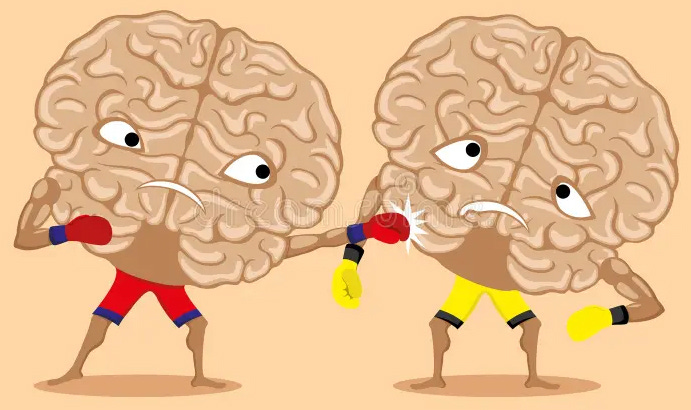
There are two parts of the human brain that really shouldn’t exist in the same head. They go together like National Guardsmen and hippies. Like sand and intercourse. Like Crossfit bros and Whole Foods cashiers who teach yoga on weekends. Understanding which message each is sending can help one decide which to heed.
The first brain part, the amygdala, is an almond-shaped thing close to the middle of the brain that showed up around 250 million years ago and is one of the oldest parts of us. It’s responsible for our fight-or-flight response and all things aggressive. If cave-you and cave-me were standing on either side of a steak that could only feed one of us, the amygdala is what would compel each of us to fight for that steak. In cave days, it served our species well by weeding out weaker iterations of human and increasing our odds of survival in both the short- and long-term. It’s not hard to see how amygalites could become a thing, especially in circumstances where access to food and other resources was unpredictable. If you’re reading this, thank the amygdala.
About 50 million years after the amygdala showed up, our brains welcomed a whole new region: the cerebrum. The cerebrum is where higher thought lives. Language, communication, pattern recognition, memory, the fine motor function that allows us to create and play musical instruments and to appreciate the music we make. It’s because of the cerebrum that we began to understand the value of communities. It’s where we learned to farm and to share resources. It’s where we realized the value of passing our knowledge on to our children. It’s ethics. It’s growth. It’s nuance. In short, it’s what makes humanity beautiful.
So let’s review: Amygdala = competition (I’ll fight you for that steak). Cerebrum = cooperation (let’s find a way to get enough steak for both of us). Compete or cooperate. Fight or forward. See the conflict? Maybe you recognize these polarized attributes in, say, political parties?
If you doubt that conservatives are amygdala-forward while liberals are all about the cerebrum, I invite you to visit websites that represent both sides and scan the language. Conservative messaging is exclusively focused on competing and fighting and the preservation thereof. It lives to feed the amygdala by constantly suggesting that there are imminent threats to your well-being. It reduces the complexity of our existence to “us vs. them.” For hardcore conservatives, it’s all about owning libs. Maybe that’s why whenever a Republican senator or congressperson is asked about the Epstein list or how exactly tax cuts for the wealthy could benefit the country, they run, head down, to their offices and call recess. Don’t bother me with facts, I’m busy winning.
On the other hand, the core language used in liberal messaging tends to focus on preserving or increasing community and providing for the least of us. It’s about building and sharing resources and solutions that serve all because a) none of us asked to be here and b) you never know where the next brilliant idea is going to come from so let’s give everyone a shot. Granted, liberal media definitely engages its amygdala in its phrasing, but that fight is more often waged in defense of the belief that we are only as good as the least among us.
So which brain is right? Well, I can only tell you which one I root for and why. I identify more with the liberal mindset and values for this simple reason: while the amygdalites were busy fighting and inspiring others to fight all these milenia, the cerebros were studying and working to create a better society (I believe this is why more members of the armed forces identify as conservative while more researchers and faculty identify as liberal). Thanks to the efforts of the cerebros, we figured a LOT of shit out. Like how to provide basic human needs for everyone on the planet many, many times over (ping me if you need links to support this fact). And not only do we know how to do these once impossible things, but just in the past few decades we have experienced an exponential increase in knowledge about how to do these things in ways that respect the planet — sometimes, even help it heal.
This renaissance has allowed us to rethink how we produce food, clothing, shelter and more. We can now produce crops without soil, using a fraction of the water and energy. This flexibility allows us to produce the food much closer to the point of consumption, thereby reducing strain on our logistics infrastructure. We can also synthesize textiles that not only keep us more comfortable in any weather, but actually track our well-being and alert us to any health risks. We can create homes that actually increase the health of the planet — homes that don’t require energy to heat or cool, that use green/renewable energy sources, that use and treat water efficiently. We can capture the energy that visits itself upon our planet in amazing ways. We now understand and can even manage our atmosphere like never before (to clarify: not by creating storms that destroy only red states, ya crazy bastards. I’m talking about stuff like controlling emissions and using the planet itself to sequester carbon). If you really look at what we’ve learned in just the past few years you’d be giddy and proud. Verily, it’s an amazing time to be alive!
I could go on and on about all the technology that we now have at our disposal (and I might in a future post). The solutions are legion. Unfortunately, their numbers are nearly matched by those who flood the social media and news channels with disinformation. Among the most common of the arguments against climate solutions in particular is that we can’t afford the fix. When I’ve traced these arguments back to their source, I see that most of them are either bots or real people who work for the fossil fuel industry. As Upton Sinclair observed, “It is difficult to get a man to understand something when his salary depends upon his not understanding it.” That same logic plays out in nearly every part of our lives where someone could make a profit.
On the larger scale, regarding us “affording” anything, I offer this hot take: Money is a mutually agreed upon illusion. Want proof? Fine. Let’s say that the earth is dying and we need to find another planet to move to. You and I will have a contest. I’ll look for a planet in a Goldilocks orbit around a stable yellow dwarf star, with an oxygen atmosphere and drinkable water. You look for one with a good economy. I will bet you a gazillion dollars that I win. Because yours doesn’t exist. Money isn’t real. It’s merely a tool we invented to help us manage resources at a time when the availability of those resources was uncertain. One could argue that the only reason money is still important enough to keep us from doing what science says we need to do is that those amygdala-forward people who happened to have a shit ton of steak are trying to preserve a mentality that doesn’t dilute their status. Hotels on Park Place, bitch. We ain’t quitting this game until the house burns down.
So let’s go Darwin on this subject of amygdala vs. cerebrum. Through the lens of evolution, what happens when a trait is no longer useful or, in fact, causes harm? One possibility is offered by Science Daily:
When traits no longer provide a competitive edge, they may undergo a process called relaxed selection. This phenomenon occurs when traits that were once advantageous become obsolete in new environments. For example, the ability to recognize and flee from predators becomes less critical in predator-free habitats, leading to the erosion of traits like vigilance, caution, speed, and agility. Traits that are energetically expensive to develop or maintain tend to be phased out more quickly, such as the body armor of the threespine stickleback fish.
I don’t know about you, but I can’t think of anything more energetically expensive than propping up a system that benefits so few while posing such an existential threat to our very existence. Also, thanks to the above citation, whenever I hear any Congressperson make some flaccid argument in favor of increasing oil subsidies while criminalizing EVs, I’ll think of the threespine stickleback fish. Except with three fewer spines.
So yes, I identify as a cerebro but I acknowledge that my amygdala is still alive. If you want to meet it, cut me off in traffic or talk shit about my kids. And if you’re an amygdalite who longs for respite from the incessant fighting, try asking yourself what kind of world you want to live in. Do you want to wake up without worrying about whether this will be the day you lose your job? Or your healthcare? Or your house? Or your savings? Because we can absolutely have that world tomorrow. Put pressure on your elected officials while you still have a vote and a voice. You may reach the same conclusion that most liberals have: The truth ain’t always easy to speak. Especially when their salaries depend on them not speaking it.